FORMULATING WITH MIKE
Video credit: Hamster3d / Vetta via Getty Images
Using Simulation Tools and Physicochemical Properties to Guide Additive Selection
Part 3: Results and Discussion
By Mike Praw, Technical Service & Development Manager — Coatings and Performance Products, Indorama Ventures, The Woodlands, TX
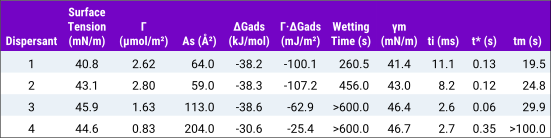
The physicochemical parameters measured and calculated for the surfactants under study can be found in Table 1. All surfactants are based on the same hydrophobe, which is represented by the letter “D” throughout this work. The difference between the molecules is the size of the hydrophilic chain comprised of poly(ethylene glycol). From 1 to 4, the size of the poly(ethylene glycol) chain increases.
As shown in equations 1, 2 and 3, the parameters Γ (excess concentration), As (area occupied by the molecule) and ∆Gads (adsorption free energy) can all be calculated from the CMC curve. The parameters γm (meso-equilibrium surface tension), ti (induction time) and tm (meso-equilibrium time) are obtained from the dynamic surface tension curve.
TABLE 1–ǀ–Experimental and calculated physicochemical parameters for the surfactants under study.
REVERSE PINCH TO ZOOM
The results in Table 1 show that, as expected, as the hydrophilic portion of the surfactant gets longer, for the same hydrophobe “D,” the molecular weight increases and, consequently, the area occupied by the molecule increases and the excess concentration, in µmol/m², reduces. Even though it does not significantly change the free energy of adsorption, it changes the surface free energy per area (Γ·∆Gads).
Surfactant 1, containing 16 moles of ethylene oxide (EO), and Surfactant 2 (18 moles EO) have a higher surface free energy per area than Surfactant 3 (25 moles EO) and Surfactant 4 (54 moles EO). This means that they are more prone to better adsorb and strongly anchor to the surface of a hydrophobic substrate such as a hydrophobic pigment like carbon black.
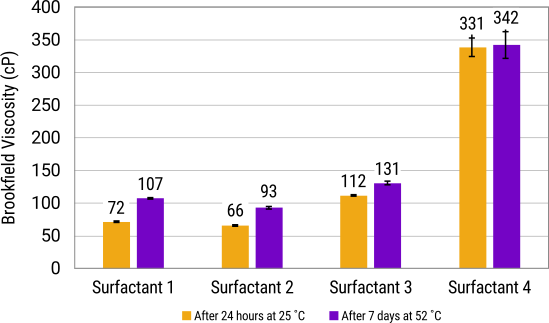
Figure 1 contains a study of viscosity reduction of a pigment concentrate made with carbon black (all-purpose regular color carbon black with low structure allowing for lower viscosity or higher pigment loadings in a variety of applications) at 40% using 12% SOP (surfactant on pigment) of each dispersant. Water is the carrier. The viscosity of each pigment concentrate was measured after 24 h stored at 25 °C and after 7 days stored at 52 °C. The graph shows a very good correlation between the calculated parameters of Table 1. Surfactants 1 and 2 presented the lowest viscosity, indicating the better dispersibility of the pigment and the best stability of the concentrate.
FIGURE 1–ǀ–Viscosity of pigment concentrates made with the surfactants under study measured after different storing conditions.
REVERSE PINCH TO ZOOM
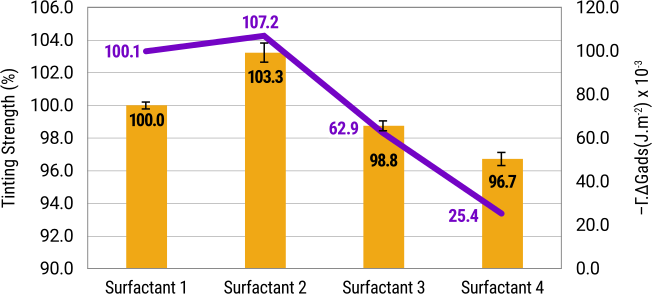
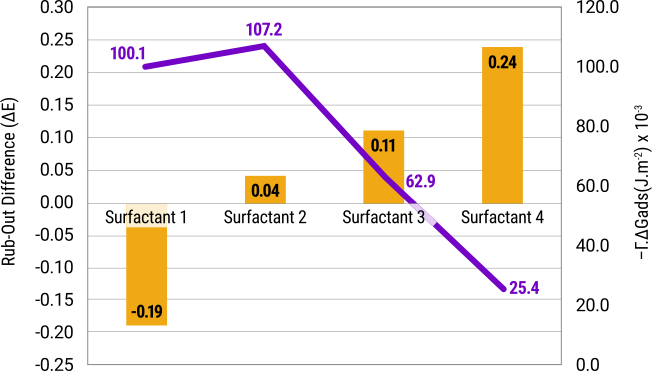
The paints made with the pigment concentrates mentioned were also tested for different properties. The two most remarkable results were tinting strength and rub-out. The paints in which the pigment concentrate made with surfactants 1 and 2 were tested are the ones that show the higher tinting strength and the lower rub-out, as highlighted in Figures 2 and 3. These results show that the use of the physicochemical parameters can be very beneficial to guide the selection of dispersants over a set of similar molecules.
FIGURE 2–ǀ–Correlation between free surface energy per area and tinting strength of paints made with pigment concentrates dispersed with surfactants 1, 2, 3 and 4.
REVERSE PINCH TO ZOOM
FIGURE 3–ǀ–Correlation between free surface energy per area and rub-out of paints made with pigment concentrates dispersed with surfactants 1, 2, 3 and 4.
REVERSE PINCH TO ZOOM
Considering this potential correlation between the free energy of adsorption per area and the dispersant performance in terms of color development, it is possible to use this tool during the development process of new dispersants to select affinic pigment groups that have the greatest adsorption capacity on the surface of the pigment of interest.
Conclusion
The results shown here demonstrate that the use of physicochemical properties obtained experimentally for surfactants can be used in the process of selecting dispersing agents. This tool can be very useful when comparing similar surfactants with differences in molecular weight or in the balance of hydrophilic and hydrophobic portions.
In next month’s column, we will look at how Hansen solubility can be used and then consider adsorption isotherms as additional methods to further the use of physicochemical constants in additive selection.
I will say that without Alann O. P. Bragatto, Suzy S. Alves, Beatriz Pinto, Rafael S. Dezotti, Robson Pagani, Bruno S. Dario and Fabricio G. Pereira (of Indorama Ventures: Indovinya Brazil), none of this would be here. Their work in this area is truly inspirational and I have learned a lot from them. In fact they are the reason we won best paper at both the 2025 Waterborne Symposium and the 2025 Eastern Coatings Show. While I accepted the awards they made it possible.
All information contained herein is provided "as is" without any warranties, express or implied, and under no circumstances shall the author or Indorama be liable for any damages of any nature whatsoever resulting from the use or reliance upon such information. Nothing contained in this publication should be construed as a license under any intellectual property right of any entity, or as a suggestion, recommendation, or authorization to take any action that would infringe any patent. The term "Indorama" is used herein for convenience only, and refers to Indorama Ventures Oxides LLC, its direct and indirect affiliates, and their employees, officers, and directors.