Silicone Oil Detection via Hyperspectral Imaging with Quantum Cascade Lasers

Credit: enturionStudio.it - stock.adobe.com
By Austin Beaudette
Applications Scientist, Block Engineering, Southborough, MA
Silicone oil can be found in a wide variety of industrial applications, whether its presence is intentional or not. Its high thermal stability, hydrophobicity, chemical inertness, and non-toxicity make silicone oil an ideal choice for lubricants, mold release agents, protective coatings and more. In some sectors, such as biomedical engineering, silicone oil coatings must remain on the product to ensure proper functionality. In other cases, it greatly hinders functionality past its initial use.
As an example, while silicone oil is necessary for mold release, even trace amounts of oil after cleaning processes can prevent topcoats from adhering to surfaces. Silicone oil contamination can also arise from mishandling or other unintended external factors, leading to the same problems but with an unknown source. For these reasons, an instrument capable of detecting silicone oil proves to be a valuable tool in confirming proper application or identifying unwanted contamination.
Available technologies for silicone oil detection on surfaces include water contact angle measurements, Raman spectroscopy, ATR-FTIR and visual inspections. While each of these has unique advantages, they also have drawbacks. Water contact angle and ATR-FTIR provide high sensitivity, but they require physical contact with the target surface. Raman spectroscopy can be used at a standoff, but non-eye-safe lasers often result in fluorescence interference. There is a need for a sensitive, noncontact, eye-safe instrument that can detect and identify silicone oil, and quantum cascade laser (QCL) infrared spectroscopy provides a solution to that problem.
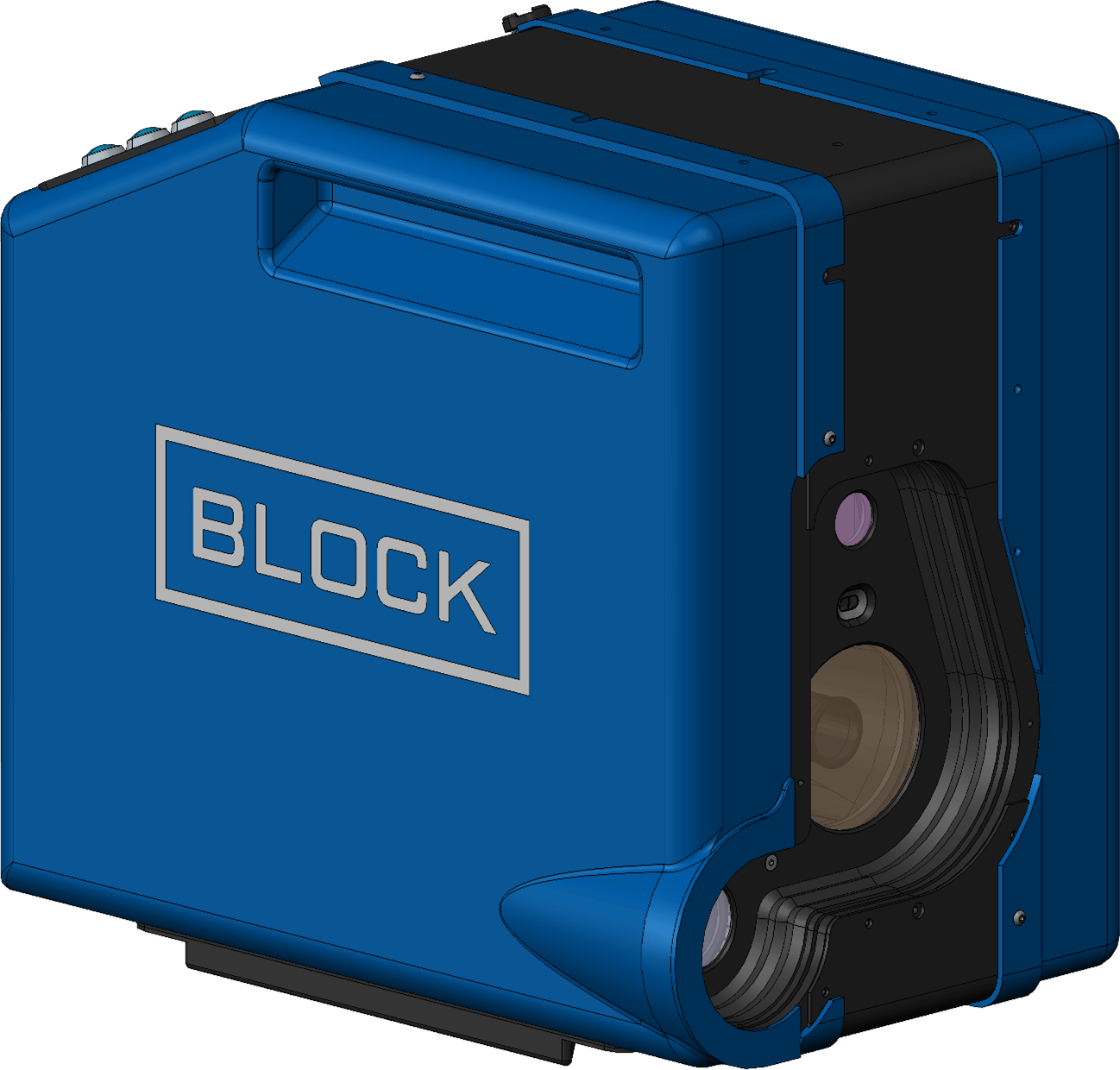
The LaserScan™ by Block Engineering is a QCL-based, noncontact surface analysis sensor that can detect, identify and image silicone oil and other chemicals. Utilizing infrared absorption spectroscopy and hyperspectral imaging, this sensor can analyze a wide variety of surfaces and check for the presence of trace or bulk chemicals with a customizable chemical detection algorithm. It can be installed into a manufacturing line for automated quality control checks or used as a nontethered tool for spot checks. Additionally, the exact locations of silicone oil can be identified during a measurement due to its hyperspectral imaging capabilities. This enables identification of silicone oil contamination or confirmation of proper application where silicone oil is required.
Credit: Option 1 Placement
Credit: Courtesy of Block Engineering
Technology
The LaserScan surface analysis sensor operates via quantum cascade laser technology. These compact lasers are widely tunable in the mid-infrared “fingerprint region,” where many molecules exhibit unique absorption features, enabling identification. Multiple QCLs can be combined to provide gap-free tuning over a specified range, emitting light with high accuracy and reproducibility. The highly selective nature of QCLs allows for sensitive surface identification through reflectance spectroscopy.
The operating principle of QCL-based infrared spectroscopy is that when infrared light interacts with a substance, the molecules can absorb energy at specific wavelengths corresponding to their vibrational modes. The remaining nonabsorbed light is then reflected off the surface, and this light can be collected by an infrared detector to create a reflectance spectrum. By analyzing the features of the spectrum, unique chemical identification can occur.
Infrared spectroscopy can be combined with hyperspectral imaging to capture not only spectral data of the interrogated surface, but spatial data as well. Hypercubes are datasets captured via hyperspectral imaging, and they are comprised of reflected light intensity data for each pixel in the detector’s array for each wavelength in the tunable range. The measured intensities are combined across all wavelengths to create a full spectrum for each individual pixel. Upon acquiring this hypercube, a chemical detection algorithm can sweep over the spatial image to highlight the location of identifiable chemicals or materials, including silicone oil.
Silicone Oil Detection
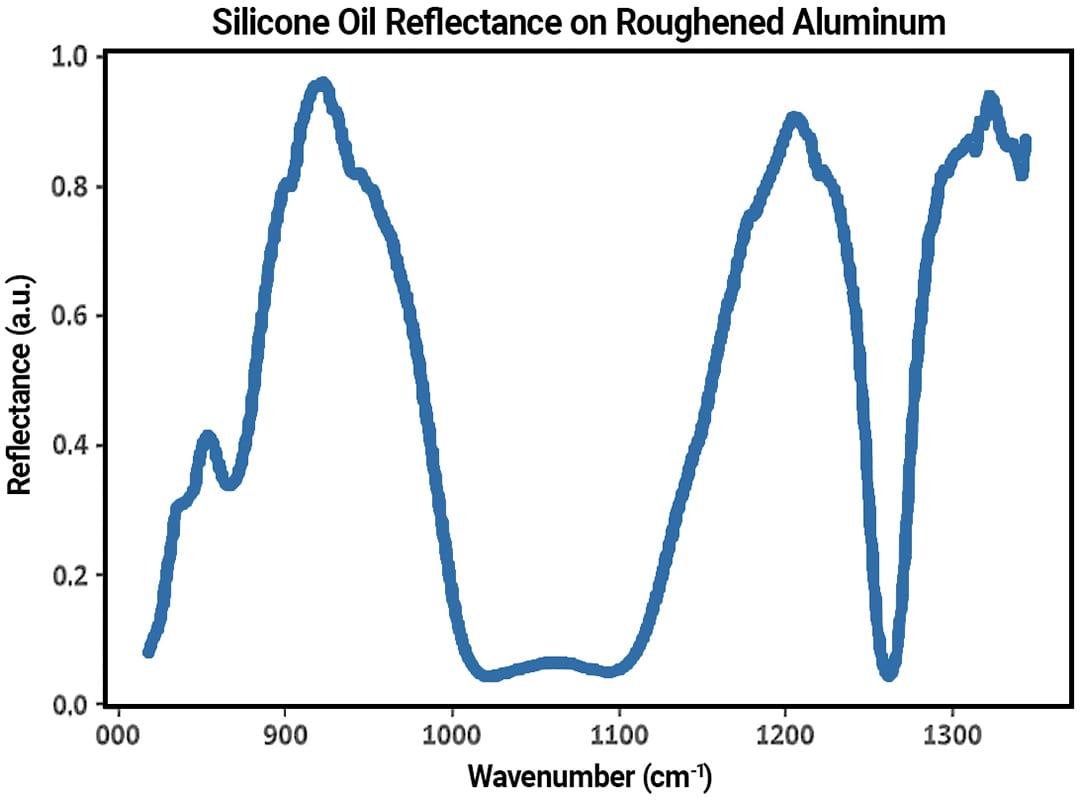
Silicone oil, or polydimethylsiloxane (PDMS), exhibits two strong absorption features in the mid-infrared “fingerprint region” that can be used for identification purposes. The first comes from stretching of the Si-O-Si siloxane bonds in the approximate 1000–1100 cm⁻¹ range, and the second comes from the bending of the Si-CH₃ methyl group bonds near 1260 cm⁻¹. Figure 2a shows a measured reflectance spectrum of a thin film of silicone oil (<100 µg/cm²) on roughened aluminum where both features are prominently visible.
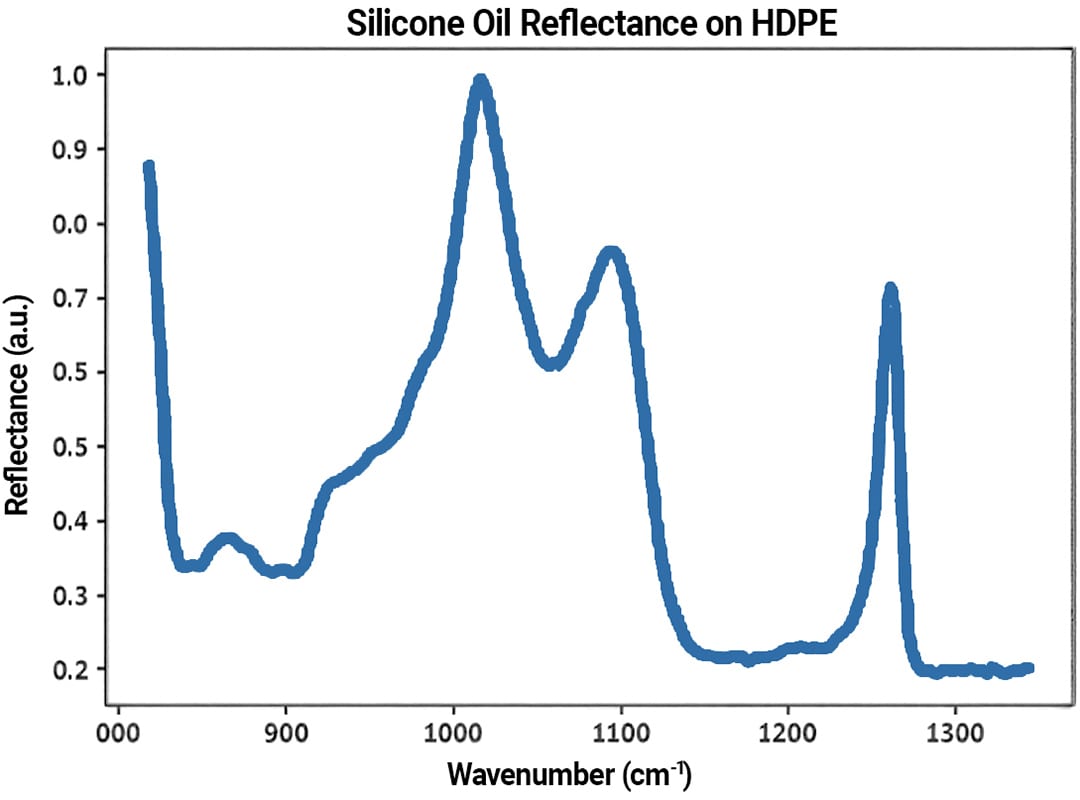
It is important to note that metals are conductors, whereas plastics are insulators. This changes how the reflected light behaves, but the characteristic absorption features remain. Figure 2b shows a measured reflectance spectrum of a similar thin film of silicone oil on HDPE plastic. Different surfaces can further alter the spectra, but specialized detection algorithms can reliably identify those variants as silicone oil.
Figure 2a. IR spectrum of silicone oil on aluminum.
Credit: Courtesy of Block Engineering
Figure 2b. IR spectrum of silicone oil on HDPE.
Credit: Courtesy of Block Engineering
Silicone oil’s limit of detection (LOD) varies by surface, influenced by factors such as material, roughness and finish. On most surfaces, silicone oil can be detected at concentrations below 100 µg/cm², and rougher surfaces have demonstrated detection at levels below 10 µg/cm². While more stringent applications may require lower thresholds, these LODs are sufficient for quality assurance and process control in many manufacturing environments.
Detection sensitivity also strongly depends on the laser’s angle of incidence (AOI). Rougher surfaces diffusely scatter light, so an AOI of about 30° is recommended to maximize the measured signal without oversaturating the detector. For smoother surfaces where specular reflection is more common, an AOI of 5–10° is recommended. Measurements at AOIs below 5° risk oversaturating the detector, though this too varies by surface.
Hyperspectral imaging takes reflectance spectroscopy a step further by providing an infrared image of the surface. After taking a measurement and compiling a hypercube, a detection algorithm can sweep over the spatial image and evaluate the collected spectral information. Areas where silicone oil is detected can then be combined to create a detection map that reveals trace contamination on the surface, with spatial resolutions capable of reaching 100 µm.
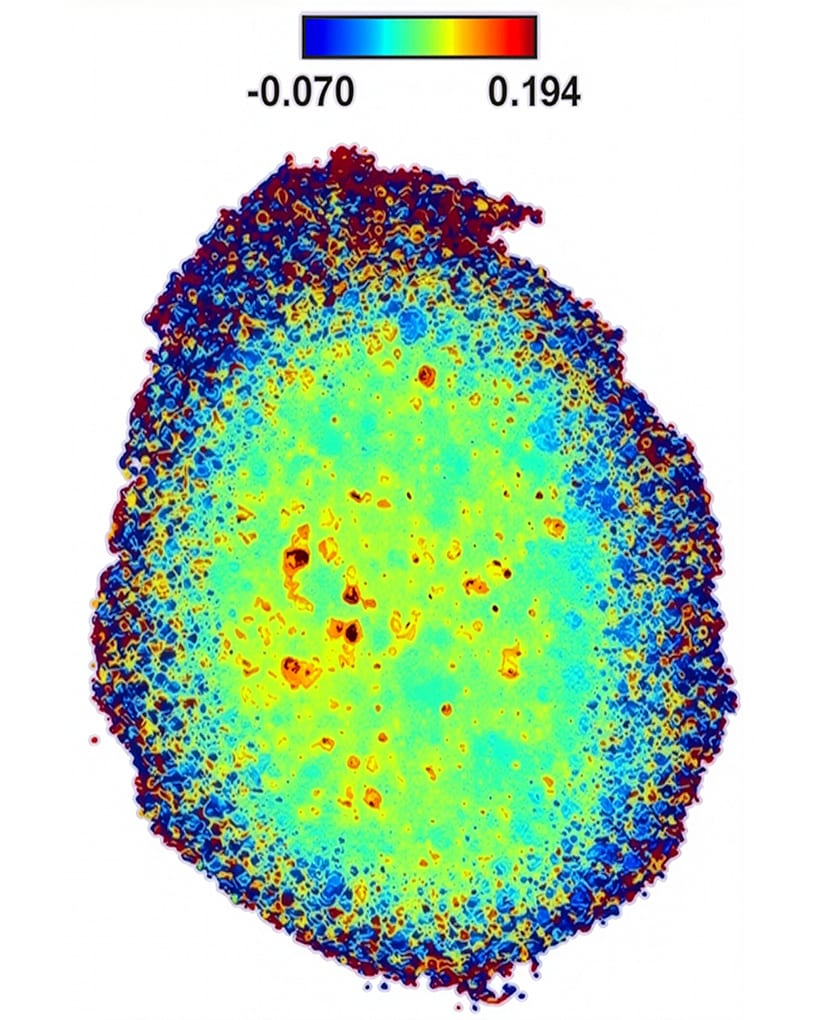
An example of hyperspectral imaging is shown in Figures 3a–d, where an approximate 2 × 2 cm “X” was drawn on HDPE using silicone oil. The hyperspectral image displaying IR light intensity (Figure 3a) does not reveal silicone oil contamination, but the detection map (Figure 3b) reveals a rough “X” shape where silicone oil was detected, highlighted in red. The resulting reflectance spectrum from the highlighted areas (Figure 3d) reveals a silicone oil spectrum, while the spectrum of the nonhighlighted parts (Figure 3c) is representative of the blank substrate, HDPE plastic.
Figure 3a. IR spectrum of silicone oil on aluminum.
Credit: Courtesy of Block Engineering
Figure 3b. Detection map of a silicone oil “X” on HDPE. The location of silicone oil contamination is highlighted in red.
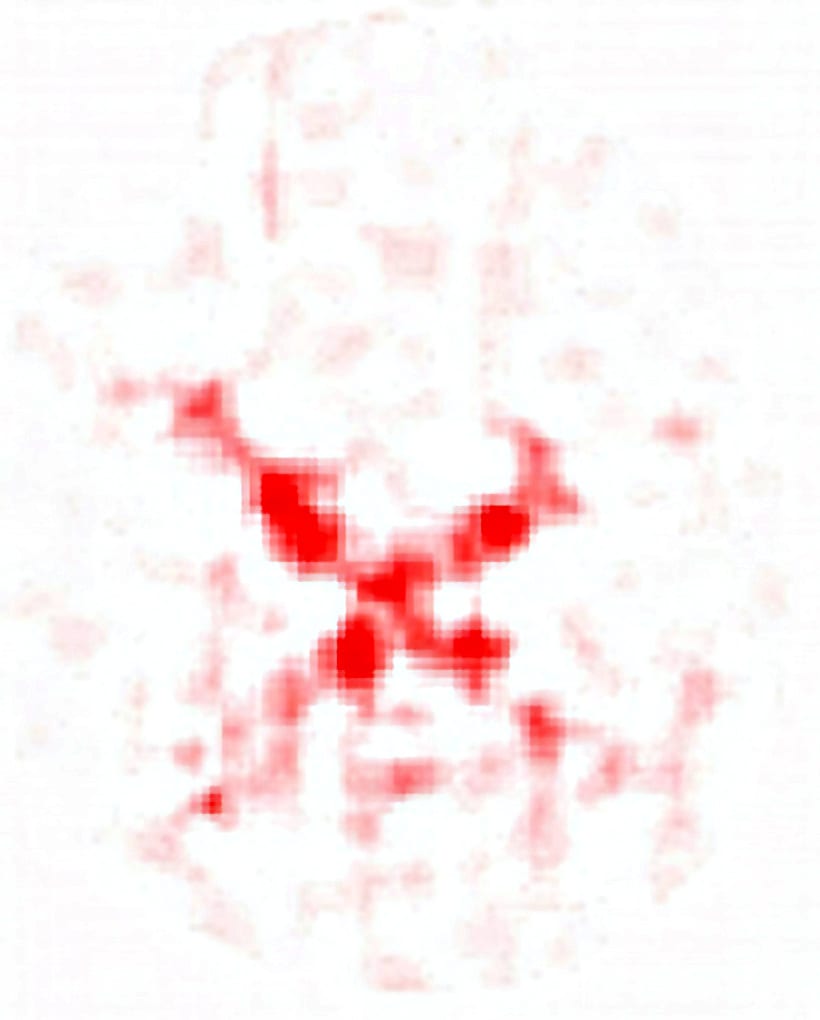
Credit: Courtesy of Block Engineering
Figure 3c. Reflectance spectrum of the nonhighlighted area from the detection map, or HDPE.
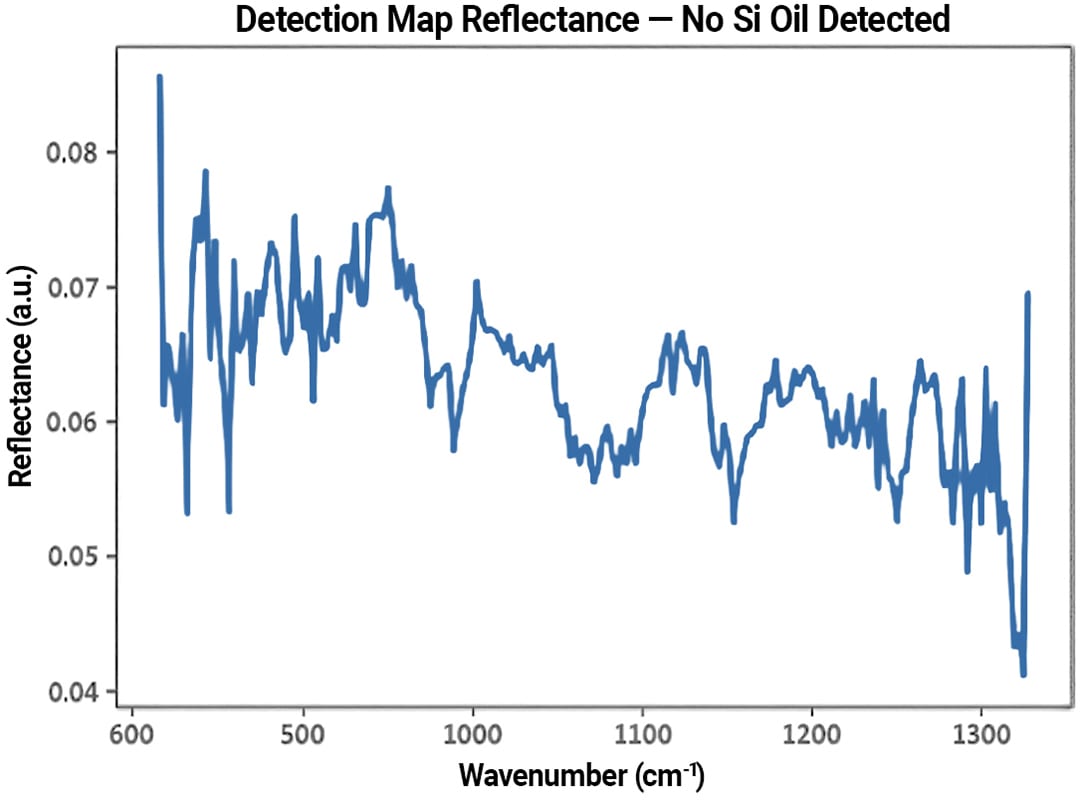
Credit: Courtesy of Block Engineering
Figure 3d. Reflectance spectrum of the highlighted silicone oil contamination from the detection map.
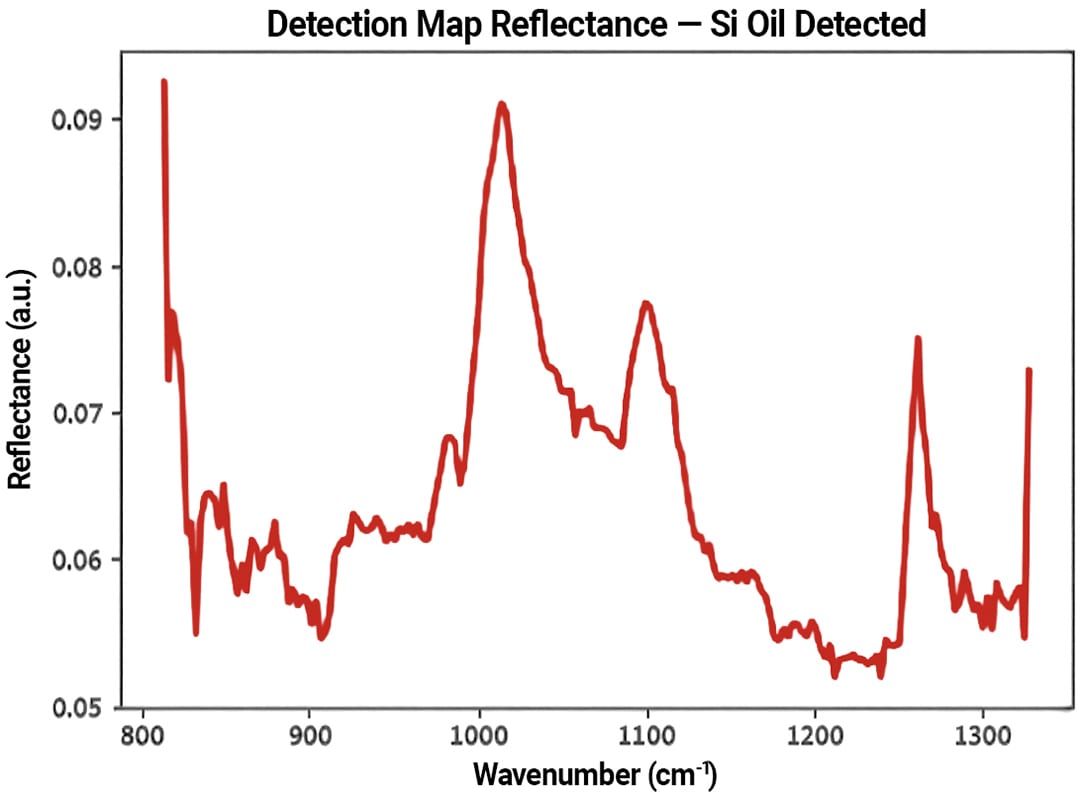
Credit: Courtesy of Block Engineering
Conclusion
Silicone oil can be both an indispensable and detrimental chemical for manufacturing processes. While it is valuable when used as a lubricant, it can lead to surface adhesion failure if left uncontrolled. Additionally, other products rely on silicone oil for proper functionality. Whatever the case, a sensitive, noncontact, eye-safe tool that can scan surfaces for silicone oil proves to be important.
The surface analysis technology discussed in this article uses quantum cascade lasers and hyperspectral imaging to detect, identify and image silicone oil and other chemicals of interest, including silicone-based coatings, on a variety of surfaces. The system combines absorption spectroscopy for chemical detection with hyperspectral imaging to help identify the location of contamination on the target surface.
With limits of detection in the tens of micrograms per square centimeter and spatial resolutions reaching 100 µm per pixel, the technology may support product quality initiatives, process control efforts and contamination monitoring in manufacturing environments.