COATINGS SUPPLIER HANDBOOK
Credit: xgH / xx via xx


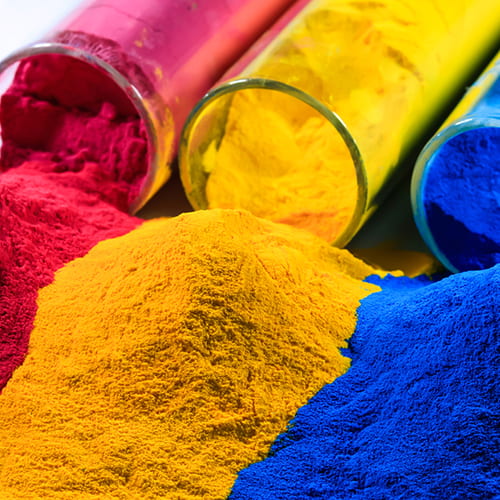

The Coatings Supplier Handbook brings together essential solutions for formulators and manufacturers across the paint and coatings industry. This annual resource highlights new technologies, raw materials, equipment, software and services offered by leading suppliers. Use this guide to navigate the latest innovations and connect with partners who can support your product development, manufacturing and compliance goals.
Click on the “▼” next to each category to expand its definition, and explore featured suppliers offering solutions in that area.
Additives ▼
Though additives comprise a small percentage of a coating formulation, their impact is significant. Additives contribute to ease of manufacture, stability of the coating product in the package, ease of application, quality and appearance.
Additive function is almost always specific in nature. In recent years, more multipurpose additives have been developed, thus allowing the use of fewer additives in many formulations. Occasionally, the use of one additive will require the use of another to counter some undesirable effect of the first. The focus on green technology, sustainability, nanotechnology, lower cost and safer products has led to the introduction of newer additives and chemistries. With a larger number of additives available for a particular problem, formulators can find themselves in trouble if the wrong additive is used. Correct additive selection is important to success, and such selection is made through sound assistance or years of experience.
Source: J.V. Koleske, R. Springate, and D. Brezinski, “2013 Additives Handbook,” Paint & Coatings Industry, June 2013.
CLOSE DESCRIPTION








Distributors ▼
The relationship between chemical/raw material distributors and coatings manufacturers is not just about product delivery. Today’s distributors offer a broad range of services that continue to help players throughout the supply chain produce innovative products in a safe and timely manner, while addressing industry trends and various economic issues.
Distributors strive for collaborative relationships focused on mutual success. Some materials/chemicals suppliers may not have the resources available for in-house testing and formulation capabilities, new product development efforts or personnel who are experienced in regulatory and compliance issues. Others may have had to reduce these activities due to economic factors. Whatever the reason, many distributors have responded to these trends by expanding their own facilities and expertise in order to offer needed services.
Additional potential benefits of working with a distributor can include inventory flexibility, access to local inventory, supply security, market analysis and visibility, supply chain expertise and digitalization.
Source: Paint & Coatings Industry and Adhesives & Sealants Industry magazines.
CLOSE DESCRIPTION


Equipment ▼
Numerous types of equipment are used throughout coatings production and application. For example, mixers are commonly used to process raw materials during the manufacturing process. The objectives of mixing are to produce a mixture with a composition and/or particle size distribution that approaches the uniform state on a scale of size appropriate to the use of the mixture, in a manner that suits the subsequent processing operations. Additional types of equipment can facilitate blending, dispersing, filling, metering, milling, converting and more. Equipment is also used to test or measure different coating properties, including color, flow, hardness, resistance to abrasion or scratching, bond strength, thickness, tack, weathering, etc. Companies can provide the instrumentation used for these measNumerous types of equipment are used throughout coatings production and application. For example, mixers are commonly used to process raw materials during the manufacturing process. The objectives of mixing are to produce a mixture with a composition and/or particle size distribution that approaches the uniform state on a scale appropriate to the use of the mixture, in a manner that suits the subsequent processing operations. Additional types of equipment can facilitate blending, dispersing, filling, metering, milling, converting and more. Equipment is also used to test or measure different coating properties, including color, flow, hardness, resistance to abrasion or scratching, bond strength, thickness, tack, weathering, etc. Companies can provide the instrumentation used for these measurements, or they can be contracted to provide various testing services in their own labs.
The equipment needed to precisely apply coatings depends on the specific coating method, such as thermal spraying, hot dipping, electrodeposition, slot die, bar, coil, curtain, brushing, rolling and more.
Many coatings require a curing step in order to achieve their final desired characteristics. The specific equipment needed, such as lamps, conveyors or ovens, depends on the material to be cured and the curing method, such as electron beam, LED, ultraviolet, infrared or spot. urements, or they can be contracted to provide various testing services in their own labs.
The equipment needed to precisely apply coatings depends on the specific coating method, such as: thermal spraying, hot dipping, electrodeposition, slot die, bar, coil, curtain, brushing, rolling and more.
Many coatings require a curing step in order to achieve their final desired characteristics. The specific equipment needed (e.g., lamps, conveyors, ovens) depends on the material to be cured and the curing method, such as electron beam, LED, ultraviolet, infrared or spot.
Source: “Equipment Handbook,” Adhesives & Sealants Industry.
CLOSE DESCRIPTION



Pigments ▼
Pigments provide color, opacity and other performance properties in paint and coatings. Organic pigments are carbon-based colorants used across many commercial products, while inorganic pigments often come from mineral or metal compounds and can provide durability, opacity and specialty performance.
Pigments may also be supplied as dispersions, in which pigment particles are stabilized in a liquid carrier to help improve handling, incorporation and color development. Dispersions can be based on water, solvent or resin systems and are often used to support consistent color and performance in coating formulations.
Source: Brenntag; SpecialChem; Chromaflo Technologies.
CLOSE DESCRIPTION
Resins ▼
Resins are organic compounds that are used to produce paint and coatings for a variety of applications, from traffic marking and architectural paints to industrial and marine coatings. The term resin comes from “resinous,” a description of materials that are amorphous and brittle, yet soft and tacky. In some cases, resins provide tackiness and increase in specific adhesion; in other cases, they provide film forming and a reduction in viscosity. The types of resins used depend on their application and the qualities needed, such as UV resistance, moisture resistance or transparency.
Vinyl and acrylic monomers, the building blocks of polymers, are used to produce some paint and coating resins. Solution, emulsion and dispersant polymers are a few types of polymers used in the coatings industry. Diols and polyols are also used to make resins for coatings and paint products.
Epoxy resin coatings are often used in industrial settings due to their ability to handle moderately corrosive environments. Acrylic paint and coatings are typically used in the architectural industry. These resins offer superior gloss and color retention, making them suitable for exterior and interior applications. Solvent-based acrylic resins usually have better chemical resistance and weather resistance compared to water-based acrylic resins, however many resin suppliers are focusing their R&D efforts to change this. Alkyd resins are also used for architectural paint and coatings due to their high gloss. These resins have high durability as well. Urethanes are versatile resins that can be used for several types of applications.
Source: “Raw Materials, Chemicals, Polymers and Additives Handbook,” Adhesives & Sealants Industry, March 2021; and Gantrade.
CLOSE DESCRIPTION

Software ▼
Software supports coatings research, development and production by helping teams capture, organize, analyze and share scientific data. In formulation work, software may be used to manage experiments, document results, connect laboratory data, visualize performance trends and support collaboration across R&D teams.
In the paint and coatings industry, software can include electronic lab notebooks, chemical drawing tools, data analytics platforms, formulation management systems and workflow tools that help scientists move from experimental design to testing and decision-making. These systems can improve data access, reduce duplicated work and support more informed formulation development.
Source: Revvity Signals Software; Revvity Signals Notebook.
CLOSE DESCRIPTION